The most important vehicle question in the Masai Mara in 2026 is no longer simply “Land Cruiser or van?”
It is whether you are doing a road safari or a fly-in safari, whether your game-drive vehicle is private or shared, and whether the open-sided vehicle you want can legally be used for the transfer you are paying for.
That distinction matters because Kenya’s Tourism Regulatory Authority issued a specific clarification on 15 January 2026: open-sided Land Cruisers are approved for game viewing and photography inside designated wildlife areas, but not for use on public roads and highways.
For travellers, that changes both logistics and cost.
The three vehicle setups you are actually choosing between
1. Closed 4×4 Land Cruiser with pop-up roof
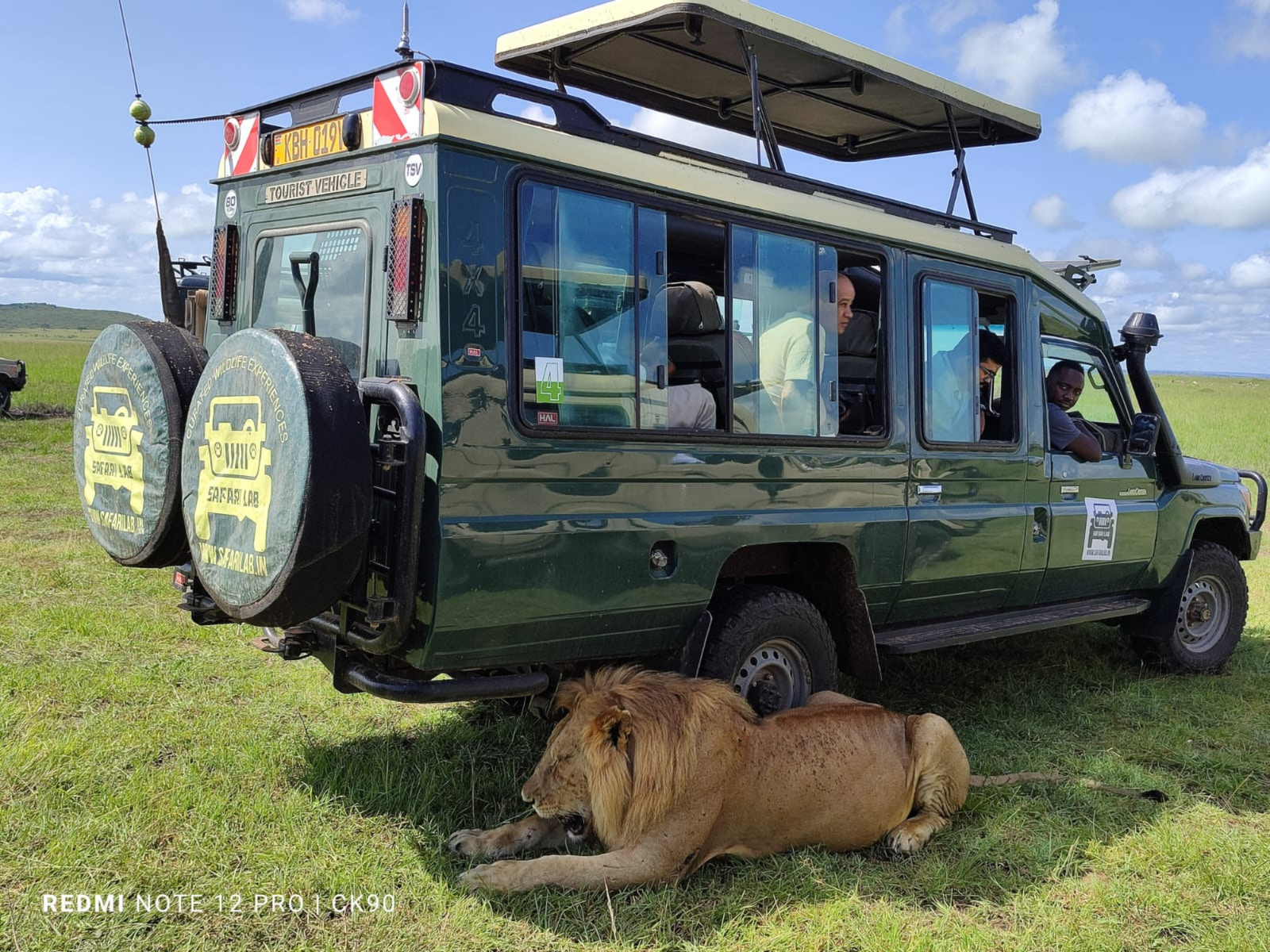
This is the standard vehicle we prefer for most private road safaris. It is enclosed for the Nairobi transfer, has proper four-wheel drive and ground clearance for rougher Mara tracks, and the roof opens for game viewing once you are inside the wildlife area.
Its biggest operational advantage is simple: one vehicle can do the whole job.
The same Land Cruiser can collect you in Nairobi, drive you to the Mara, conduct your game drives for several days and return you to Nairobi at the end.
2. Safari van or minibus
Safari vans remain a legitimate lower-cost option in Kenya. They usually have a pop-up roof and can work perfectly well in normal dry conditions, particularly on established routes.
The difference becomes more noticeable when tracks deteriorate, rain creates deep ruts, ground clearance matters or the route involves rougher access roads. A proper 4×4 gives the guide more options and more margin.
That does not mean a van automatically gives you a poor safari. A well-maintained van with a very good guide can produce a far better wildlife experience than a badly maintained Land Cruiser with a weak guide.
3. Open-sided Land Cruiser
Open-sided Land Cruisers are excellent game-viewing vehicles. Visibility is superb, photography from seated height is easier and the vehicle feels more connected to the landscape.
But the 2026 regulatory position is important. In its 15 January press release, Kenya’s Tourism Regulatory Authority stated that open-sided Land Cruisers are licensed and approved strictly for game viewing and photography within designated wildlife areas — national parks, national reserves and registered conservancies.
The Authority also stated that these vehicles are not designed or approved for use on public roads and highways and directed tour operators to use them exclusively within those wildlife areas.
Why an open-sided vehicle can make a road safari more expensive
This is the part many quotations do not explain clearly.
If you are driving from Nairobi and also want an open-sided Land Cruiser for game drives, you need two transport functions:
- an enclosed road-legal vehicle to take you from Nairobi to the Mara;
- an open-sided vehicle operating inside the Reserve, park or conservancy.
At the end of the safari, you also need the return transfer back to Nairobi unless you are flying out.
So the operator is no longer costing one vehicle across the entire itinerary. There is a transfer vehicle cost and a separate game-drive vehicle cost.
Nairobi transfer vehicle → Mara wildlife-area vehicle → Nairobi transfer vehicle.
That is why a road itinerary with an open-sided vehicle can cost more than a road itinerary using one closed Land Cruiser throughout, even when the lodge, park fees and number of nights are identical.
The extra cost is not because an open-sided Land Cruiser is automatically a “luxury vehicle”. It is because you have created a second piece of transport that also has to be positioned, staffed and paid for.
Fly-in / fly-out is a completely different calculation
If you fly from Wilson Airport to a Mara airstrip and fly back at the end, there is no Nairobi–Mara highway vehicle to cost.
You land inside or close to the wildlife area, are collected by the lodge or camp vehicle and use that vehicle for your game drives.
In that setup, an open-sided vehicle makes far more operational sense because it is being used for exactly what it was designed and licensed for: game viewing inside the wildlife area.
This is why travellers sometimes compare two quotations and misunderstand the difference. One quote may look expensive because it includes both road transfers and a separate open-sided safari vehicle. Another may include flights and shared camp game drives. They are not costing the same transport structure.
And a fly-in safari does not automatically mean a private vehicle
This is another important distinction.
Many lodges and camps include scheduled game drives in their own vehicles, but those vehicles may be shared with other guests. If you want exclusive use, a private vehicle can be an additional cost and may need to be reserved in advance.
Current 2026 terms from properties such as &Beyond Bateleur Camp and Kichwa Tembo explicitly state that private 4×4 safari vehicles can be pre-booked subject to availability.
So there are really two separate questions:
- What type of vehicle am I in?
- Is that vehicle private to me?
An open-sided vehicle shared with several other guests may give you better visibility than a closed Land Cruiser, but less control over where you go, how long you stay at a sighting and when you return to camp.
2026 road reality: Sekenani is easier than many people think
As of 2026, the main Nairobi–Sekenani route is paved all the way to Sekenani Gate. Current destination guidance puts the Nairobi–Mara road distance at roughly 230 km and the drive at around five hours in normal conditions.
That does not mean every Mara access route is now easy tarmac.
Approaches toward northern and western areas can still involve substantial unpaved sections. SafariBookings currently notes an unpaved stretch of around 70 km after Narok for some northern approaches.
So when someone says “the road to the Mara is good now”, the useful follow-up is: which part of the Mara?
For our own itineraries, we still allow realistic road time rather than selling the drive as a quick transfer.
Why four-wheel drive matters more after rain
In dry conditions, many tracks are perfectly manageable in both vans and Land Cruisers.
After heavy rain, the calculation changes. Parts of the Mara have black-cotton soil that becomes slick, deep ruts develop and apparently straightforward tracks can become much harder.
A proper high-clearance 4×4 gives the guide more options, particularly on rougher access tracks and during wetter periods.
But four-wheel drive is not permission to drive irresponsibly. The best guides often avoid a bad section before getting stuck in it.
The vehicle is also your photography platform
For photographers, vehicle configuration matters almost as much as the camera body.
Roof opening, seat spacing, window height, whether you can move from one side to the other, where camera bags can be stored and how many people are trying to use the same opening all change the experience.
A Land Cruiser carrying seven people can be a worse photography platform than a van carrying four.
“Seven-seater” does not tell you whether the vehicle will feel crowded
The useful question is not the advertised seating capacity. It is how many people will actually be in the vehicle on your safari.
At a lion sighting, several people may want to stand at once. At a leopard sighting, everybody may want the same side. If a cheetah starts moving, cameras, beanbags, binoculars and people all shift together.
This is why we ask about actual occupancy rather than simply accepting a label such as “7-seater Land Cruiser”.
Closed Land Cruiser versus open-sided vehicle for photography
Open-sided vehicles make side-on shooting easier and often give excellent low seated angles.
A closed Land Cruiser with a pop-up roof gives more protection from dust, cold and rain on transfers, while still providing very good game-viewing access through the roof.
Neither automatically wins. The bigger differences are often vehicle occupancy, guide positioning and whether you control the vehicle privately.
Families should think about space differently
Families need room for water, snacks, jackets, bags and sometimes a sleeping child. They also need the flexibility to stop when necessary.
A private vehicle often matters more to a family than the exact body style. A child needing a toilet break or an early return is easy to manage when the vehicle belongs only to your party.
If a family of four is being put into a vehicle simply because it can technically carry several more passengers, we would still ask how much usable space remains.
Older travellers should ask about entry height
A high-clearance Land Cruiser is excellent off-road, but it can be harder to climb into than a lower van.
For guests with limited mobility, knee problems or back problems, ask about steps, handholds and seat access rather than assuming “4×4” automatically means more comfortable.
What about air-conditioning?
For a conventional road-safari Land Cruiser, air-conditioning is not the deciding factor we would use.
During actual game drives the roof is open and windows may also be open. Ventilation, seat comfort, dust sealing during highway transfers and overall space are usually more useful considerations.
What happens when a vehicle gets stuck?
It happens even to experienced guides.
A proper 4×4 gives the driver more tools — traction, clearance and low-range gearing — but judgement is still more important than bravado.
Good guides know when not to enter a section that is deteriorating.
Do you need a winch, snorkel and expedition-style accessories?
Usually no.
A safari vehicle is not being judged in an off-road competition. Good tyres, sound suspension, mechanical reliability, sensible recovery equipment and a skilled driver are far more important than accessories fitted for appearance.
Why two quotations can differ even when both say “Land Cruiser”
“Land Cruiser included” tells you surprisingly little.
One quote may mean:
- a private closed Land Cruiser from Nairobi for the entire safari;
- a transfer vehicle to the Mara plus a separate open-sided vehicle;
- a fly-in package with shared lodge game drives;
- a fly-in package with a private vehicle supplement;
- a high-occupancy shared vehicle;
- a private vehicle with only your party inside.
Those are completely different products.
What you should ask before booking
- Is the safari vehicle a closed Land Cruiser, safari van or open-sided Land Cruiser?
- Is it private to our party or shared?
- What is the maximum actual occupancy?
- If we are driving from Nairobi and want an open-sided vehicle, what separate transfer vehicle is being costed?
- Is the return Nairobi transfer included?
- If we fly in, are airstrip transfers and game drives included?
- Are lodge game drives shared by default?
- What is the supplement for a private camp vehicle?
- Does a closed vehicle have a pop-up roof?
- For photographers, how many usable shooting positions are there?
Land Cruiser vs van vs open-sided 4×4 in 2026
| Closed 4×4 Land Cruiser | Safari van | Open-sided Land Cruiser | |
|---|---|---|---|
| Public highway transfer | Yes | Yes | No — restricted to designated wildlife areas under the 2026 TRA clarification |
| Nairobi road safari | Most efficient all-in-one setup | Lower-cost option | Requires a separate highway-transfer solution |
| Fly-in safari | Possible | Uncommon | Very well suited |
| Wet/rough conditions | Strong | More limited | Strong inside wildlife areas |
| Photography | Excellent at sensible occupancy | Good at sensible occupancy | Excellent visibility |
| Privacy | Depends on booking | Depends on booking | Often shared unless private use is specifically booked |
| Cost structure | One vehicle can often cover transfer + safari | Usually lowest road-safari vehicle cost | Can add a second vehicle cost on drive-in itineraries |
What Safari Lab usually prefers
For a private road safari from Nairobi, we generally prefer one closed 4×4 Land Cruiser throughout.
It keeps the logistics simple, avoids paying for two vehicle functions and gives the guide continuity from the first transfer to the final game drive.
If a guest specifically wants an open-sided vehicle, we would first ask whether the trip should become fly-in/fly-out. That often makes more operational sense than paying for highway transfers and then paying separately for another vehicle inside the Mara.
That does not mean fly-in is automatically cheaper. Airfare, airstrip transfers, lodge rates and private-vehicle supplements all matter. It means the structure is cleaner because the open-sided vehicle is being used only where it is legally and practically intended to operate.
The cheapest vehicle is not always the cheapest safari
A lower-cost vehicle can save money, but only if it still fits the route and group.
A more expensive vehicle can also be poor value if it is crowded, badly maintained or paired with a guide who does not understand how you want to safari.
The correct comparison is not “Land Cruiser versus van” in isolation.
It is:
transfer structure + road capability + group size + privacy + game-drive control + photography space + guide quality.
The vehicle is part of the safari, not a transfer detail
Travellers often spend days comparing lodges and then accept one line saying “transport in safari vehicle”.
That line can determine more of the actual wildlife experience than the difference between two room categories.
Before booking, understand exactly what vehicle is collecting you, what vehicle is taking you on game drives, whether those are the same vehicle, how many other people are inside it and whether a private-vehicle supplement exists.
For related planning, see our Masai Mara game-drive guide, Private vs Group Safari guide, Nairobi to Masai Mara guide and photography safari guide.
Sources used for the 2026 update
Kenya Tourism Regulatory Authority: 15 January 2026 press release, Use of Open-Sided Land Cruisers on Public Highways. The directive restricts open-sided Land Cruisers to game viewing and photography within designated wildlife areas and states that their use on public highways is non-compliant with licensing and safety requirements.
SafariBookings: current Masai Mara access guidance, including the paved Nairobi–Sekenani route and remaining unpaved access toward northern Mara areas.
&Beyond: current 2026 Bateleur Camp and Kichwa Tembo terms noting that private 4×4 safari vehicles can be pre-booked subject to availability.