
Masai Mara Hot Air Balloon Safari: Is It Worth It?
At USD 450 per person, this is one of the Mara’s most expensive optional experiences. The question is not whether it gives you a better game drive. It is whether flying over the savannah as the sun rises is worth adding to your safari.
The short answer
For many first-time visitors, yes — provided the cost fits comfortably within the overall safari budget. The experience is difficult to replicate on the ground: lifting off in the pre-dawn light, watching the horizon brighten, then drifting over open savannah, river lines and wildlife as the Mara wakes below you.
But it is important to buy it for the right reason. A balloon is not a wildlife-chasing vehicle. It follows the wind. You may pass directly over elephants, giraffe, zebra, wildebeest or other wildlife — and that can be unforgettable — but you cannot direct the balloon toward the best sighting happening elsewhere that morning.
The sheer experience of flying over wildlife as the sun rises over the savannah is what makes ballooning special. Treat any particular wildlife sighting as a bonus, not the reason to book.
What does it cost?
The rate is the same for adults and children. There is no separate child rate in the price we currently quote.
At USD 450 per person, a family of four is spending USD 1,800 on one morning. That is why we do not treat ballooning as an automatic inclusion. It should be weighed against the core safari: number of Mara nights, vehicle quality, lodge location and park access.
Worth prioritising when
You want a once-in-a-lifetime sunrise experience, the extra cost fits the trip comfortably, and you are not sacrificing an important part of the core safari to pay for it.
Skip or defer when
The USD 450 would force you to cut a Mara night, compromise the vehicle, or choose a substantially worse lodge location. Protect the safari first.
Why the flight path is wind-dependent
A hot-air balloon does not steer like an aircraft or a safari vehicle. The pilot controls ascent and descent and can sometimes use wind moving in slightly different directions at different altitudes, but the overall route is determined by the wind.
This matters when guests hear that a lion pride, cheetah, leopard, river crossing or large migration herd has been seen in a particular area. Even if that sighting is active during your flight, the balloon may simply not travel in that direction.
Likewise, two balloons launching on different mornings from the same general area can have different flight paths because wind conditions have changed.
If close wildlife action is your priority, a game-drive vehicle is the better tool. Ballooning is about perspective, atmosphere, scale and the chance encounters the wind gives you.
What the morning actually feels like
The experience starts in darkness. Guests are collected from camp well before sunrise and driven to the launch site. After the safety briefing, the balloon is inflated and passengers board the basket for take-off around dawn when conditions are suitable.
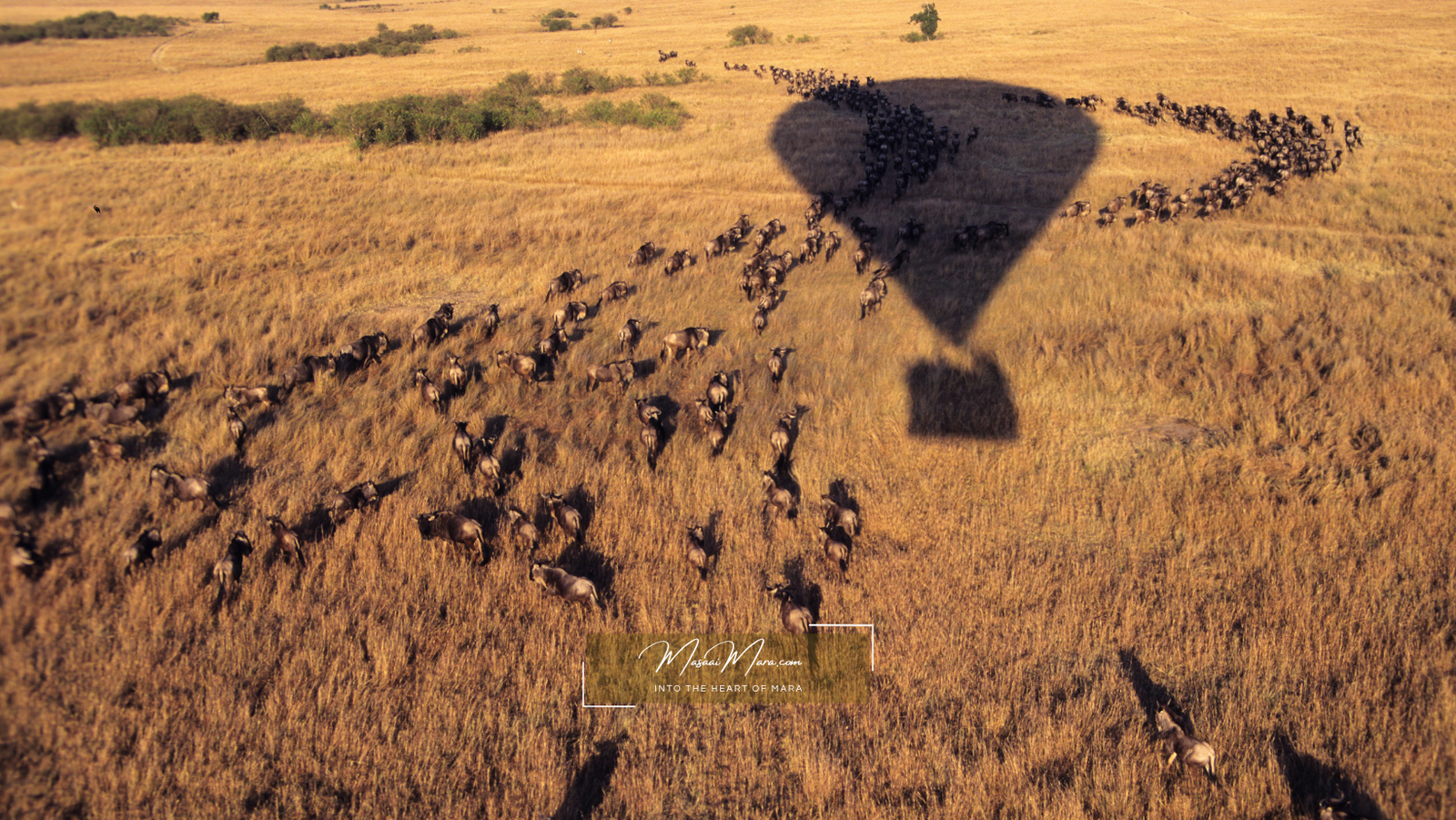
The first few minutes are often the most memorable. The ground slowly drops away, the burner becomes intermittent, and the Mara opens up beneath you. As daylight builds, tracks, river lines, herds and isolated animals become visible in a way that is impossible from ground level.
It is the contrast that gives the experience its value: the scale of the landscape, the relative silence between burner bursts, and wildlife moving below while the sun comes up across the savannah.
Flight time is commonly around an hour, although wind and landing conditions determine the actual duration. The full excursion is much longer because it includes pickup, preparation, landing, breakfast and transfers.
What wildlife can you see?
Potentially a great deal. Elephants, giraffe, buffalo, antelope, wildebeest and zebra are particularly striking from the air because you can see how they use the landscape rather than only viewing individual animals at vehicle level. Predators can also be seen, but that is never something to promise.
The balloon is especially good at revealing scale: a herd crossing an open plain, elephants moving between woodland patches, hippo paths leading away from water, or migration animals spread across kilometres of grassland.
But wildlife can also be sparse along the particular route the wind gives you. That does not mean the flight has failed; it simply reinforces why the aerial experience itself has to be the primary reason for booking.
Balloon vs game drive
Balloon
Best for sunrise, landscape, scale, aerial views and the novelty of drifting above wildlife. The route is wind-dependent and you cannot stop over a sighting.
Game drive
Best for close wildlife, behaviour, photography at eye level, following tracks and changing direction when guides receive information about an active sighting.
They complement each other. One should not be sold as a replacement for the other.
How it affects your game-drive morning
A balloon morning occupies a substantial part of the early safari window. Depending on where you land, where breakfast is served and how transfers are arranged, you may be able to continue game viewing afterward, but you should not assume you will have a normal dawn game drive as well.
On a very short Mara stay, this trade-off matters more. With three or four Mara nights, it becomes much easier to include ballooning while still protecting enough dawn and full-day game-drive time.
See How Many Nights in Masai Mara? and our Kenya safari itinerary guide.
Is migration season the best time?
Migration months can produce extraordinary aerial scenes when large herds are in the area, but even then the wind decides whether the balloon passes over them. A river crossing taking place several kilometres away is not something the pilot can simply divert toward.
Outside the migration period, resident wildlife and the landscape still make ballooning worthwhile. Green-season flights can produce saturated colours and dramatic skies; drier months can offer wide visibility and beautiful low-angle sunrise light.
Read our Great Migration guide and Best Time to Visit Masai Mara.
Weather and cancellation
Wind is central not only to the route but also to whether the balloon can fly safely at all. Pilots need suitable wind and visibility conditions, and flights can be delayed or cancelled when conditions are unsafe.
Refund and rescheduling policies depend on the operator. We prefer scheduling the balloon before the final Mara morning where possible so there is at least some itinerary flexibility if weather disrupts the planned flight, although rebooking is always subject to operator availability.
Children, mobility and medical considerations
Even though the price is the same for adults and children, participation rules are set by each balloon operator. Minimum ages, height requirements and pilot discretion can vary, so the chosen operator’s current policy should be checked before booking.
Parents should also consider the very early start, burner noise, standing in the basket and the landing procedure. Balloon landings can sometimes be firm, so passengers may need to crouch or brace as instructed.
Guests with back, hip, knee, mobility or other medical concerns, and pregnant travellers, should check suitability directly with the chosen operator before paying.
Photography from the balloon
The best photographs are often wider than people expect. A standard zoom is excellent for sunrise, landscape, shadow and herd compositions. A 70–200mm can help isolate wildlife without becoming unwieldy inside the basket.
Do not plan the flight around close predator portraits. Even when the balloon passes over wildlife, altitude, direction and speed are determined by the flight rather than by the photographer.
Keep the setup simple, secure straps properly and avoid repeated lens changes around dusty launch and landing sites. See Masai Mara Photography Safari.
What is normally included?
Typical balloon packages include collection from specified lodges or camps, the balloon flight, landing transfer and a post-flight breakfast. Exact inclusions vary by operator and location, and some protected-area, transfer or other charges can differ.
For Safari Lab itineraries, the working balloon supplement is USD 450 per person for both adults and children. We confirm the applicable operator, pickup logistics and current terms against the guest’s lodge and travel date when the safari is booked.
So, is it worth USD 450?
Yes, if what you want is the experience itself. There is something genuinely extraordinary about lifting off before sunrise and watching the Mara unfold beneath you as the first light reaches the plains — especially when the flight path brings you over wildlife.
No, if you are buying it as a shortcut to better sightings. The balloon cannot chase a cheetah, turn toward a reported lion sighting or guarantee a migration herd. A good private game drive will always give you more control over wildlife viewing.
For travellers who can comfortably afford both, we see ballooning as one of the most memorable optional experiences in the Mara. For travellers choosing between ballooning and the quality of the safari itself, we choose the safari.
Customised wildlife safaris across India & Africa.
Plan your Masai Mara safari · WhatsApp 9889884763
Frequently asked questions
How much is a Masai Mara hot air balloon safari?
Safari Lab currently quotes USD 450 per person. The price is the same for adults and children.
Can the balloon fly toward a lion or cheetah sighting?
No. The route is primarily determined by the wind. The pilot can manage altitude but cannot steer the balloon toward a particular wildlife sighting like a safari vehicle can.
How long is the flight?
Approximately an hour in the air is common, although actual duration depends on wind and safe landing conditions. The complete excursion takes several hours.
Will I see the Great Migration from the balloon?
You may see large herds if the flight path passes over them, but migration sightings and river crossings cannot be guaranteed because the balloon follows the wind.
Is ballooning better than a game drive?
No. It is a different experience. Game drives are better for close wildlife and following behaviour; ballooning is about sunrise, aerial perspective and the scale of the Mara.